
How to Tell if an Anime Figure Store Is Legit Before You Place an Order
To tell if an anime figure store is legit, verify transparent policies, real contact details, consistent product information, believable pricing, and store behavior that matches a genuine specialist retailer before you order. In practice, a trustworthy store makes it easy to confirm who they are, what they sell, how shipping works, and what happens if something goes wrong.
Once you know what to look for, use the same checklist when you browse the full collector figure catalog, especially when reviewing photos, policies, and product details.
If you are trying to decide whether an anime figure shop is legit, do not focus on one clue alone. A polished homepage or a low price is not enough. The safer approach is to check several trust signals together: store identity, product-page quality, payment and policy transparency, and whether the site behaves like a real hobby retailer instead of a throwaway storefront.
Quick Legitimacy Checklist Before Ordering
If you want the fastest possible screen, use this checklist before you place an order from any unfamiliar anime figure website:
- Can you find clear contact details beyond a generic form?
- Are shipping, returns, cancellations, and pre-order policies easy to find and understand?
- Do product pages name real brands, lines, release details, or figure specs? For shoppers exploring this further, see collectible statues.
- Does pricing look believable for the type of figure being sold?
- Does the store show consistent catalog focus instead of random unrelated products?
- Are stock claims, delivery times, and discounts stated in a realistic way?
- Can you verify outside reputation through store reviews, community mentions, or collector discussions?
- Does checkout use recognizable payment methods and a secure HTTPS site?
If several of these answers are weak, the store may not be worth the risk.
Step 1: Check Whether the Store Looks Traceable
A legitimate store should be easy to identify as a real business. That does not mean every good store needs a flashy About page, but it should give you enough information to understand who is behind it.
Look for:
- a real contact email tied to the domain
- a business name used consistently across the site
- an About, Contact, or customer-service page with concrete details
- a visible country or operating region
- social accounts or external profiles that match the same brand identity
Be more cautious when a store gives you almost nothing beyond a contact form and a payment button. Thin identity makes disputes harder and often shows the site was built for quick transactions rather than long-term trust.
Step 2: Read the Policies Like a Buyer, Not Like a Skimmer
One of the best ways to judge store legitimacy is to read the policy pages that impatient shoppers usually skip. Trustworthy stores generally explain expectations before they take your money.
Policy checklist that matters most
Pay close attention to these pages:
- Shipping policy: processing times, carrier expectations, international options, customs or import notes, and whether pre-orders ship separately
- Return policy: return window, eligibility, condition requirements, and whether opened figures can be returned
- Cancellation policy: especially important for pre-orders and special-order items
- Damage or missing-item policy: how quickly you must report problems and what evidence they require
- Privacy and payment terms: these should exist and read like real operating documents, not copied filler
A weak shipping policy usually creates uncertainty about when items actually leave the warehouse. A weak return policy matters even more because it tells you what happens when the order arrives damaged, delayed, or not as described. Good stores do not hide these rules in vague one-line disclaimers.
Step 3: Inspect Product Pages for Signs of a Serious Figure Retailer
A real specialist store usually treats product pages like the core of the business, not like disposable placeholders.
Positive signs include:
- clear brand names such as Good Smile Company, Kotobukiya, Banpresto, MegaHouse, Alter, or similar established makers
- specific product naming instead of generic phrases like “anime PVC model toy gift”
- useful details about scale, size, materials, release window, or manufacturer
- photos that look consistent across the catalog
- category organization that makes sense for collectors, such as brand, series, or figure type
Red flags include:
- duplicate product descriptions pasted across unrelated items
- random capitalization or awkward keyword stuffing
- cropped, inconsistent, or low-trust images
- product pages with no release details, maker info, or meaningful specifications
- a catalog that jumps from anime figures to unrelated bargain items with no clear niche
Collectors asking how to tell if an anime figure store is legit should treat product-page quality as evidence of operational seriousness. Careful stores usually know that buyers want release details, authenticity confidence, and condition expectations.
Step 4: Judge the Pricing Pattern, Not Just One Cheap Item
Low pricing attracts buyers fast, but it is one of the easiest trust signals to misread. A legit store can run a sale. A risky store can also look tempting by undercutting everyone.
The question is whether the price pattern feels believable.
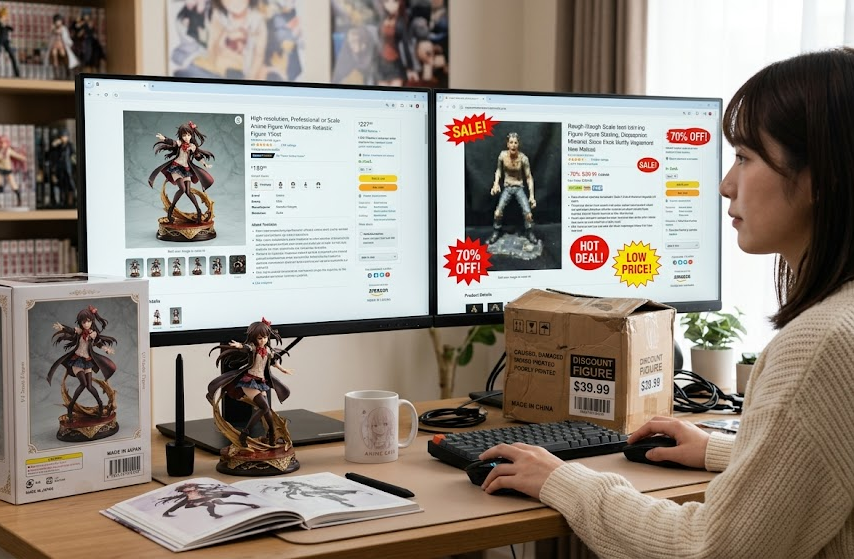
Pricing and discount patterns that deserve caution
Be careful when you see:
- huge discounts across nearly the entire store all the time
- prices far below what similar licensed figures usually cost
- countdown timers or urgency banners on almost every page
- “in stock” claims for many hard-to-find figures with no nuance
- inconsistent pricing between similar products that makes no retail sense
A realistic store may offer a few strong deals, clearance items, or preorder promotions. But if every figure looks improbably cheap, that often means the business model depends on impulse buying before trust questions catch up. For shoppers exploring this further, see cheap anime figure websites red flags.
Step 5: Look for Reputation Outside the Store Itself
A store controls its own website, so it should not be your only source. Before ordering, search for signals elsewhere.
Useful outside checks include:
- collector forum threads or hobby subreddit mentions
- social comments that discuss shipping speed, packing quality, and customer support
- store reviews that mention specific figure orders rather than generic praise
- repeated complaints about non-delivery, fake tracking, poor communication, or bait-and-switch behavior
Do not overreact to one angry review. Every retailer gets complaints. What matters is the pattern. A few normal shipping delays are not the same as multiple buyers saying they never received support or that the store ignored refund requests.
Step 6: Check the Checkout Experience for Basic Trust Signals
A legitimate store should feel normal at checkout. That sounds obvious, but checkout behavior often reveals whether the business expects repeat customers or just wants quick payments.
Look for:
- HTTPS and a secure browser connection
- recognizable payment methods
- order-confirmation expectations
- reasonable shipping-cost disclosure before final payment
- no pressure to pay through unusually risky channels unless clearly justified
If a store pushes you toward odd payment flows, hides shipping until the last second, or feels messy and inconsistent during checkout, pause. For shoppers exploring this further, see shop anime figures. The checkout experience is part of the trust test, not just the final step.
Red Flags vs Trust Signals at a Glance
| Area | Trust signals | Red flags |
|---|---|---|
| Contact details | domain-based email, business identity, clear customer-service path | no real contact info, only a form, inconsistent store name |
| Policies | specific shipping, return, cancellation, and damage rules | vague one-line policy pages or copied filler text |
| Product pages | real brands, specs, release details, consistent catalog quality | generic titles, poor images, thin descriptions, random product mix |
| Pricing | believable discounts and normal range variation | store-wide extreme markdowns and unrealistic deals |
| Reputation | outside discussion with mixed but credible real-buyer feedback | repeated reports of ghosting, fake tracking, or wrong items |
| Checkout | HTTPS, standard payment methods, clear costs | risky payment requests, hidden charges, chaotic checkout flow |
What a Trustworthy First Test Order Looks Like
If you still are not fully sure, the smartest move is usually a controlled first purchase instead of a large preorder. A careful test order helps you measure how the store handles real fulfillment. For shoppers exploring this further, see trusted anime figure stores for beginners.
A low-risk first order usually means:
- choosing a lower-cost in-stock item rather than an expensive rare figure
- avoiding a massive multi-item cart on the first purchase
- saving screenshots of the listing, policy pages, and order confirmation
- tracking how quickly the store communicates after payment
- checking packaging quality and item accuracy when the order arrives
This matters because even a store that looks decent on paper still has to prove it can ship properly, pack carefully, and respond like a real retailer.
If you would rather browse within a figure-focused catalog while comparing stores, ShelfFigure’s Japanese anime figures collection gives you a cleaner reference point for how a specialist store presents products and categories.
FAQ
How can I tell if an anime figure store is legit?
Check multiple trust signals together: real contact details, clear shipping and return policies, believable pricing, complete product pages, outside reputation, and a normal secure checkout experience.
What should I check before ordering from a new figure website?
Start with policies, contact information, product-page quality, payment methods, and outside buyer feedback. Those five areas tell you far more than homepage design alone.
Are low prices enough to trust a store?
No. Low prices can be legitimate, but they can also be bait. What matters is whether the pricing pattern, product information, and store behavior all make sense together.
What store policies matter most for anime figure buyers?
Shipping policy, return policy, cancellation terms, and damage-handling rules matter most because they define what happens when pre-orders move, boxes arrive damaged, or the item is not what you expected.
Summary Takeaway
If you want to know how to tell if an anime figure store is legit, think like a risk filter, not like a bargain hunter. The safest stores are the ones that are easy to trace, transparent about policies, consistent on product pages, realistic on pricing, and normal during checkout. If a store makes basic answers hard to find, treat that friction itself as the warning sign.