
Glass vs Acrylic Display Cases for Anime Figures: Which One Makes More Sense for Collectors?
If you want the short version, glass display cases usually make more sense when you care most about scratch resistance, a more premium cabinet feel, and long-term visual clarity, while acrylic display cases make more sense when lower weight, safer handling, and easier room changes matter more. For most anime figure collectors, the better material depends less on “which is objectively best” and more on whether you are building a permanent display or a flexible one.
If you are choosing between materials, browse display cases for figures and check how the size, door style, and dust protection fit your room.
In plain terms, glass is the more stable, harder-wearing option for a polished long-term setup, while acrylic is the more forgiving option for apartments, smaller rooms, lighter furniture, and collectors who move things around often. That is why the best display case material for anime figures changes depending on your budget, the value of your collection, how often you clean, and how much you trust your room to stay calm and collision-free.
Quick Answer by Collector Type
Here is the practical decision most collectors actually need.
| Collector type or priority | Glass display case | Acrylic display case |
|---|---|---|
| Wants the most premium furniture look | Better fit | Good, but usually less premium-looking |
| Hates visible scratches | Better fit | Weaker fit |
| Lives in an apartment or moves often | Riskier because of weight | Better fit |
| Wants a light single-figure box or stackable setup | Usually overkill | Better fit |
| Collects heavy scales or statues in a fixed room | Strong fit | Depends on thickness and build quality |
| Wants lower break risk around kids or tight spaces | Mixed: durable surface, but breakable | Often safer to handle |
| Needs lower upfront cost in smaller formats | Sometimes higher | Often better fit |
Choose glass if:
- you want a cleaner, more furniture-like presentation
- you care about scratch resistance more than portability
- your display location is stable and you do not expect frequent moves
- you are setting up a dedicated cabinet for long-term collecting
- your collection includes expensive scale figures that deserve a more polished showcase
Choose acrylic if:
- you want a lighter anime figure display case that is easier to carry or rearrange
- you live in a small room, apartment, dorm, or rental
- you are shopping for single-figure boxes, desktop covers, or modular stackable displays
- you care more about impact safety and flexibility than perfect scratch resistance
- you expect to rework your setup often as the collection changes
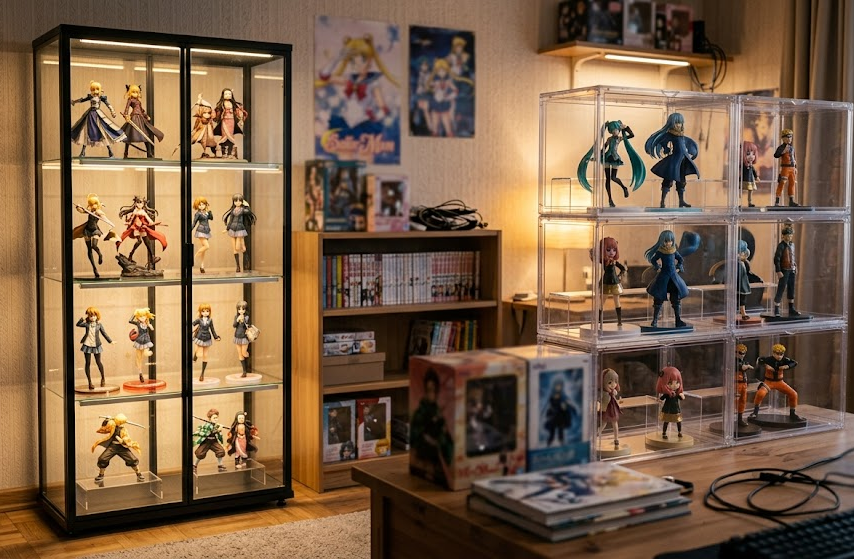
Glass vs Acrylic Display Cases: The Core Difference
The real comparison is not just glass vs acrylic as materials. For shoppers exploring this further, see current scale figures. It is surface durability and premium feel versus lighter weight and easier handling.
Glass display cases usually feel more substantial. They tend to look cleaner from a distance, resist light scratching better, and pair well with dedicated collector rooms, living-room displays, or full-height cabinets. If your goal is a more refined presentation, glass usually has the edge.
Acrylic display cases solve a different problem. They are easier to lift, easier to ship, easier to reposition, and often easier to fit into collector setups that are still evolving. That matters more than people admit. Many anime figure displays are not permanent museum installations. They are part hobby shelf, part bedroom storage, part changing room layout. In that kind of environment, a lighter material can be the smarter choice.
So when people ask whether a glass vs acrylic display case for anime figures is better, the honest answer is this: glass usually wins on finish and scratch resistance, while acrylic usually wins on flexibility and move-friendly safety.
Clarity, Scratch Resistance, and Visual Presentation
This is the category where many collectors instinctively prefer glass, and not without reason.
Glass tends to feel cleaner and more stable visually over time. It is less likely to pick up fine wipe marks from ordinary cleaning, and it often gives a more premium cabinet impression in full-room displays. If you are building a focal-point display and you want the case itself to disappear visually rather than feel like plastic furniture, glass usually makes more sense.
Acrylic can still look very good, especially in high-quality clear panels, but it asks more from the owner. Fine scratches, cleaning marks, and haze from rough handling show up faster. That does not make acrylic bad. It just means you need to be more deliberate about how you wipe it, stack it, and move it.
Where glass tends to win
- better scratch resistance during routine cleaning
- stronger premium look in larger cabinets
- more stable visual clarity in fixed long-term displays
- better fit if the case is meant to blend into furniture instead of looking modular
Where acrylic still works well
- desktop display boxes
- stackable single-character displays
- setups where low weight matters more than furniture-grade presence
- collectors who are careful about cleaning and willing to accept light wear over time
If you are still deciding on cabinet shape and visibility rather than only material, how to choose a figure display cabinet for dust protection and visibility is a useful next step.
Weight, Break Risk, and Moving Safety
This is where acrylic becomes much more appealing.
A glass figure cabinet is heavier, harder to reposition, and more stressful to move through tight rooms, stairs, and rental spaces. That does not matter much if the cabinet will stay in one place for years. It matters a lot if you rearrange often, expect to move apartments, or simply do not want every layout change to become a two-person project.
Acrylic display cases are usually easier to handle, especially in smaller formats. For collectors who buy stackable display boxes or desk-friendly covers, the lower weight is one of the biggest real-world advantages. It also reduces the stress of lifting cases around figures, shelves, or cramped corners.
For apartments and small rooms
Acrylic often makes more sense because:
- it is easier to carry through narrow spaces
- it is less intimidating to reposition during cleaning
- it usually feels less risky in compact layouts
- it works better for collectors who do not want very heavy furniture
For heavy statues and permanent setups
Glass can still make more sense when:
- the cabinet is staying put
- the display is part of a dedicated room setup
- the collection includes larger, heavier pieces that deserve a more stable furniture base
- the goal is long-term presentation rather than modular convenience
That said, the “safer” choice depends on what kind of accident you are imagining. Acrylic is usually safer to handle and less stressful during moves. Glass usually resists everyday scratching better but carries more risk if something goes seriously wrong during transport or impact.
Price and Availability Differences
Price depends a lot on format.
For full furniture-style cabinets, glass often comes with a higher-feeling finish, but price differences depend on frame quality, doors, shelves, lighting, and brand. For smaller display boxes and stackable covers, acrylic is often easier to find and more flexible in size options.
That is why collectors comparing a full glass display case to a small acrylic display box can end up talking past each other. They are not always shopping for the same type of product.
In general:
- glass cases often make more sense in full cabinet or living-room display formats
- acrylic cases often make more sense in desktop, shelf-top, single-figure, or modular stackable formats
- acrylic is often easier to find for collectors who want custom sizing or lightweight add-on protection
- glass is often easier to justify when the case is meant to behave like permanent room furniture
If your bigger question is whether enclosure itself is worth paying for, are acrylic display cases worth it for anime figures helps frame the budget side from the acrylic angle.
Best Use Cases for Cabinets, Shelves, and Single-Figure Cases
The smartest choice changes with the job the case needs to do.
Best use cases for glass
Glass makes more sense for:
- full-height figure cabinets
- living-room or office displays where furniture appearance matters
- collectors with stable homes and dedicated display corners
- curated displays of scale figures, resin statues, or centerpiece pieces
- collectors who want a more finished “gallery” look
Best use cases for acrylic
Acrylic makes more sense for:
- desktop display boxes
- stackable modular cases
- smaller shelf-top enclosures
- temporary or evolving collector setups
- apartments, dorms, and frequent-mover layouts
- single-figure protection where a full cabinet would be excessive
If you are using ordinary shelves either way
Material choice also interacts with shelf planning. For shoppers exploring this further, see resin statues. A lightweight enclosure can be easier to place on existing furniture, while a heavier cabinet needs more deliberate floor and wall-space planning. For shoppers exploring this further, see choosing a figure display cabinet. If shelf dimensions are still part of the decision, how deep a shelf should be for anime figures is worth checking before you buy anything bulky.
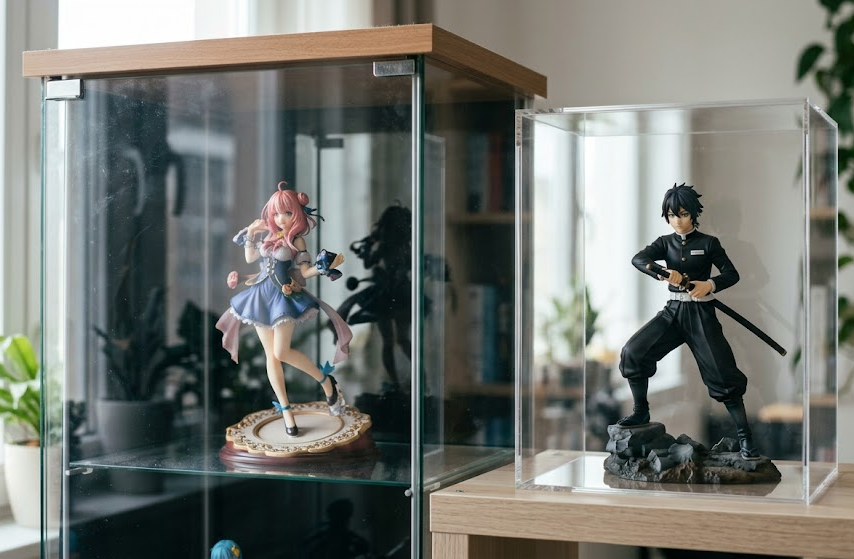
Cleaning and Maintenance Considerations
Collectors often focus on initial appearance and forget the maintenance side. That is a mistake.
Glass is usually easier to keep looking clean because it tolerates ordinary wiping better and resists fine scratching more effectively. If you know you will clean often, glass is less likely to punish you for it.
Acrylic needs a gentler touch. The material is lighter and often easier to live with physically, but careless wiping can leave visible wear faster. That means the best acrylic experience usually comes from collectors who clean carefully and do not mind being a little more deliberate.
Glass maintenance strengths
- easier routine wipe-downs
- better resistance to fine cleaning scratches
- often looks consistently polished over time
- strong fit for people who want lower visual maintenance stress
Acrylic maintenance strengths and weaknesses
- easier to remove and reposition for cleaning around the room
- lower lifting burden during setup changes
- more vulnerable to visible wipe marks and small scratches
- best when treated carefully rather than aggressively cleaned
No matter which material you choose, enclosure still helps with dust compared with open shelves. If dust control is your main concern, how to protect your anime figures from dust pairs well with this comparison.
Scenario Matrix: Which Material Makes More Sense?
If you live in an apartment and expect to move again
Acrylic usually makes more sense. Lower weight, easier handling, and less stress during room changes matter more than the premium finish advantage of glass.
If you collect heavy scales or statues in a permanent room setup
Glass often makes more sense. In that scenario, the cabinet is part of the room long term, and the premium look plus stronger scratch resistance tend to matter more.
If you want small single-figure boxes for desk or shelf displays
Acrylic usually makes more sense. That format plays directly to acrylic’s strength: light, modular, easy-to-place protection.
If you want one showcase cabinet that feels like furniture
Glass usually makes more sense. It tends to better support the “finished display centerpiece” goal.
If you have a busy room with tight walkways or shared space
Acrylic often makes more sense because it is easier to handle and less nerve-racking when the display area is not perfectly isolated.
Pros and Cons at a Glance
Glass display case pros
- better scratch resistance
- more premium cabinet appearance
- strong long-term clarity for fixed displays
- often better for dedicated collector-room presentation
Glass display case cons
- heavier and harder to move
- more stressful in apartments or frequent-move situations
- often less flexible for small modular display formats
- can feel like too much case for a casual or evolving setup
Acrylic display case pros
- lighter and easier to carry
- often safer and less stressful to handle in tight rooms
- excellent for modular, desktop, and single-figure use
- easier fit for changing collector layouts
Acrylic display case cons
- scratches more easily
- cleaning needs more care
- may look less premium in larger furniture-style setups
- can show wear faster if handled roughly
Final Verdict: When Acrylic Is Smarter vs When Glass Is Worth It
If your collection lives in a flexible, real-world setup with limited space, frequent rearranging, or likely future moves, acrylic is often the smarter choice. For shoppers exploring this further, see best Detolf alternatives for figure displays. It fits the reality of how many collectors actually live.
If your goal is a long-term showcase cabinet with a more polished furniture feel, less worry about surface scratching, and a room layout that is not changing anytime soon, glass is usually worth it.
The most useful way to think about the acrylic vs glass figure case decision is this: choose acrylic for adaptability, choose glass for permanence. That guideline is more reliable than chasing a one-size-fits-all answer.
Summary Takeaway
Glass display cases usually make more sense for collectors building a stable, premium-looking long-term display, while acrylic display cases usually make more sense for collectors who need lighter weight, easier handling, and more flexible room planning. The best choice depends on whether your anime figure display is meant to stay put or evolve with your space.
FAQ
Is acrylic or glass better for anime figures?
Neither is automatically better for every collector. Glass is usually better for scratch resistance and a premium cabinet look, while acrylic is usually better for lighter weight, easier handling, and flexible setups.
Do acrylic display cases scratch too easily?
They can scratch more easily than glass, especially if cleaned carelessly or handled often. High-quality acrylic can still look good, but it generally asks for gentler maintenance.
Are glass cases too heavy for figure collections?
Not always, but they can be inconvenient in apartments, small rooms, or homes where the display will need to move. Weight is one of the main reasons some collectors prefer acrylic.
Which display-case material is safer in small rooms or apartments?
Acrylic is usually the safer and easier material to live with in tight spaces because it is lighter and less stressful to carry or reposition. Glass can still work, but it makes more sense when the setup is stable and the room layout is forgiving.