
How to Pack Anime Figures for Moving Without Snapped Parts, Paint Rub, or Lost Accessories
The safest way to move anime figures is to remove loose parts first, wrap painted surfaces with non-abrasive materials, separate accessories in labeled bags, and use a snug outer box that prevents shifting. If you want to move anime figures safely, think in this order: disassemble, protect painted contact points, isolate every small part, cushion the figure inside a stable box, and keep heavy boxes from crushing the sculpt during transport.
Collectors usually run into trouble when they pack too fast and treat a delicate figure like ordinary home decor. Snapped pegs, bent effect parts, paint rub on hair tips, and missing accessories usually happen because parts were left attached, wrapped with abrasive material, or allowed to move around inside the box. A careful packing workflow fixes most of that before the moving truck even arrives.
Quick Answer: Safest Packing Order for Anime Figures
If you need the short version, pack anime figures for moving in this order:
- photograph the complete figure and accessory layout before touching anything
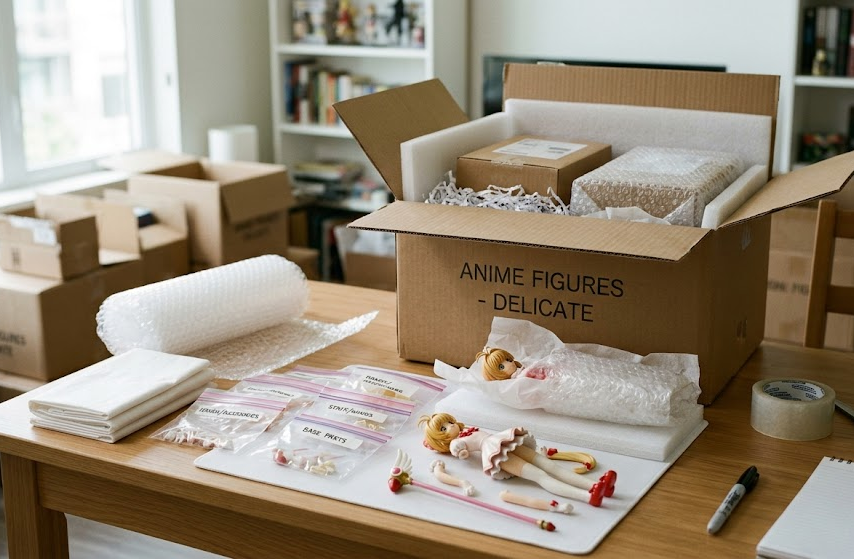
- remove the base, effect parts, swappable hands, weapons, and other loose accessories
- place small accessories into labeled zipper bags so they cannot drift between boxes
- wrap the main figure with acid-free tissue or other soft non-abrasive material before adding bubble wrap
- cushion the wrapped figure inside a snug inner container so it cannot slide
- place that container inside a properly padded moving box with clear labeling
- stack figure boxes above heavier household items, never under them
That order matters because the biggest moving risks for anime figures are not just drops. For shoppers exploring this further, see figure accessories and parts. They are friction, compression, and mixed-up parts.
Step-by-Step Checklist for Packing Anime Figures
1. Set up a clean packing station before you start
Do not break down a display shelf and improvise on the floor. Use a clean table with enough room for the figure, its base, soft wrapping materials, zipper bags, labels, and the final moving box. A stable work surface reduces the odds of dropping a part while rushing.
Before disassembly, take a few clear reference photos from the front and back. Those pictures help with re-display later and make it easier to verify whether an accessory is missing after the move.
2. Remove bases, effect parts, and every loose accessory first
This is the step collectors skip when they are tired, and it is exactly how snapped pegs happen.
Anything that can shift should come off before packing:
- bases
- support arms
- effect parts
- swappable hands or faces
- weapons and props
- detachable hair strands, tails, wings, or ribbons
If a part feels tight, do not force it at a bad angle. Warm room temperature and patient pressure are safer than sudden twisting. The goal is to move anime figures safely, not win a speedrun against delicate PVC joints.
3. Bag accessories separately so nothing disappears in transit
Small accessories are where good moving plans go to die. A missing hand part is often worse than a scuffed box because it is harder to replace.
Use one labeled zipper bag per figure, or one larger master bag with clearly separated smaller bags inside. Good labels include:
- figure name or character name
- accessory count
- left/right notes when parts come in mirrored pairs
- a quick note for fragile pegs or directional fit
If the figure came with a clear blister tray and it is still in good condition, that tray is often the safest place for odd-shaped accessories. The tray keeps parts from grinding against each other and helps prevent lost accessories during a move.
4. Protect painted surfaces before you add outer cushioning
Bubble wrap is useful, but it should not always sit directly against sensitive paint.
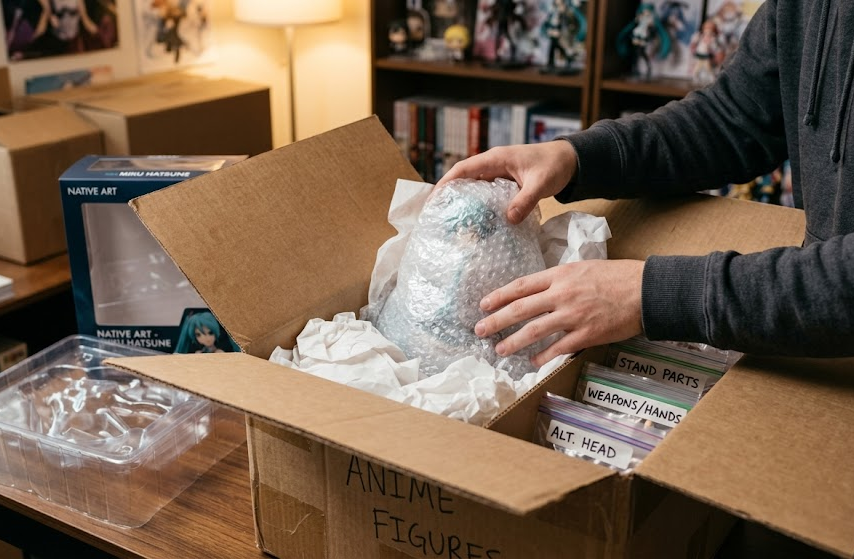
For paint-safe protection, start with a soft barrier such as acid-free tissue or another non-abrasive wrap around the figure’s painted surfaces. After that, add bubble wrap or foam cushioning outside the soft layer. This two-layer approach lowers the chance of paint rub, especially on glossy finishes, hair tips, exposed skin areas, and protruding costume details.
Pay special attention to:
- face paint and printed eyes
- metallic paint areas
- transparent effect parts
- sharp sculpt points like fingers, hair spikes, and weapon tips
- contact points where the figure might press against the inner box during bumps
The point is not to create a huge marshmallow. The point is to stop rubbing and impact while keeping the figure stable.
5. Use a snug inner fit so the wrapped figure cannot slide
Once wrapped, the figure should go into a box or inner container that matches its size closely enough to prevent drifting. Empty space is dangerous because every stop, turn, and curb hit during a move turns that spare space into momentum.
A good inner fit means:
- the wrapped figure sits securely without being compressed hard
- fragile sculpt points are not bearing the weight of the package
- padding fills gaps without pushing against the figure aggressively
- bases and heavy accessories are separated so they cannot slam into the main body
Original packaging often helps here. If you still have the original blister tray and it fits properly, it is usually one of the best ways to pack figurines for moving because it was designed to immobilize the sculpt shape.
6. Label the outer box like a collector, not like a mover in a hurry
A plain “fragile” sticker is better than nothing, but it is not enough when you are moving multiple anime figures in similar cartons.
Each outer box should clearly state:
- which figure or figure group is inside
- whether accessories are packed separately or inside the same box
- which side should stay upright
- whether the box contains delicate clear parts or tall sculpt points
- whether the original box, blister tray, or both are included
This is also the best way to stop bases and accessories from getting mixed up. If two similar figures share interchangeable-looking parts, vague labels become expensive.
Best Wrapping Materials for Paint-Safe Protection
The best wrapping material depends on what it touches.
Best first-contact materials
Use these directly against painted surfaces when possible:
- acid-free tissue paper
- clean soft non-abrasive wrapping paper
- soft foam sheeting designed for delicate items
These materials help reduce paint rub because they do not have the same aggressive surface texture as rough paper or direct plastic friction.
Best outer cushioning materials
Use these outside the soft first-contact layer:
- bubble wrap
- foam padding
- air pillows only when they are not pressing on fragile tips
Materials to avoid or use cautiously
Be careful with:
- rough packing paper directly on painted areas
- adhesive tape touching any figure surface
- overly tight plastic wrap around thin sculpt parts
- loose heavy filler that lets accessories sink and shift
If you are wondering how to wrap anime figures safely, the simplest rule is: soft layer first, impact layer second, then stable placement.
Should You Keep Figures in Their Original Packaging for a Move?
Usually, yes, if the original blister tray still fits the figure correctly and is not cracked or badly warped.
Original packaging is helpful during a move because it already accounts for the figure’s silhouette, bases, and accessory layout. It often does a better job than improvised packing at stopping movement. That said, original packaging is only useful when:
- the tray still holds the figure securely
- the plastic has not become brittle enough to crack under pressure
- the figure still fits after any display modifications or reassembly changes
- heavy accessories are positioned correctly rather than pressing against delicate paint
If the original packaging is damaged or incomplete, a custom snug inner box with careful padding is safer than trusting a bad tray.
How to Label Boxes So Parts Do Not Get Mixed Up
When several figures are being packed at once, labeling is part of damage prevention, not just organization.
A practical labeling system looks like this:
- one main box label with the character or product name
- one accessory bag label with the exact part count
- one note for special risks such as “clear wing part” or “loose hair peg”
- one quick re-display note if the figure has a tricky assembly order
If you want an easy rule, every detached part should be identifiable without opening five different bags and guessing. For shoppers exploring this further, see Display Cases. That saves time during unpacking and sharply lowers the odds of lost accessories.
What Not to Do When Stacking Figure Boxes in a Move
A careful wrap job can still fail if the box is stacked badly in the truck.
Mistakes to avoid
- putting figure boxes under books, kitchen appliances, or other dense household items
- laying boxes sideways when the internal support assumes an upright orientation
- cramming multiple wrapped figures into one box without separating their accessories and bases
- leaving enough empty space for the figure to bounce around
- stacking tall cartons so high that lower boxes start taking crushing load
Figure boxes should ride in a lighter, more controlled section of the move. If movers are involved, make it obvious that these are collector items, not random decorative objects. For shoppers exploring this further, see what to do if your figure arrives damaged.
Post-Move Inspection Checklist Before Re-Displaying
Before you put anything back on the shelf, slow down and inspect each figure in a deliberate order. For shoppers exploring this further, see shipping damage photos for a faster claim.
Quick inspection checklist
- confirm all accessories are present against your pre-move photo
- check pegs, sockets, and support arms before forcing reassembly
- look for paint rub on high-contact areas
- inspect clear parts for stress marks or hairline cracks
- let cold figures warm to room temperature before pushing tight parts together
- clean off any dust or wrap residue before re-displaying
This last step matters because some damage is easier to fix or document immediately after the move than weeks later.
FAQ
Should you keep anime figures in their original blister trays for a move?
Yes, in many cases. Original blister trays are often one of the safest ways to immobilize anime figures during transport, as long as the tray still fits correctly and is not damaged.
What wrapping material is safest for painted anime figures?
The safest first-contact materials are soft non-abrasive wraps such as acid-free tissue paper or soft foam sheeting. Bubble wrap is best used as an outer cushioning layer rather than directly against sensitive paint.
How do you pack figure accessories so they do not get lost?
Separate accessories into labeled zipper bags, note part counts, and keep each figure’s small parts grouped with its own box or blister tray. That is the easiest way to prevent mixed-up or missing accessories during a move.
Summary Takeaway
To pack anime figures for moving without snapped parts, paint rub, or lost accessories, remove loose parts first, isolate every accessory, protect painted surfaces with a soft barrier, and stop the figure from shifting inside the box. Most moving damage comes from friction, compression, and preventable part mix-ups, so a collector-style packing workflow beats generic moving advice every time.